
AI agent skills vs. boilerplates: which fits indie launches?
Templates give you a starting repo. Launch skills teach your AI agent how to architect, integrate, and deploy a full product — without locking you into one stack.

Brandon
AI agentsboilerplatesindie hacker
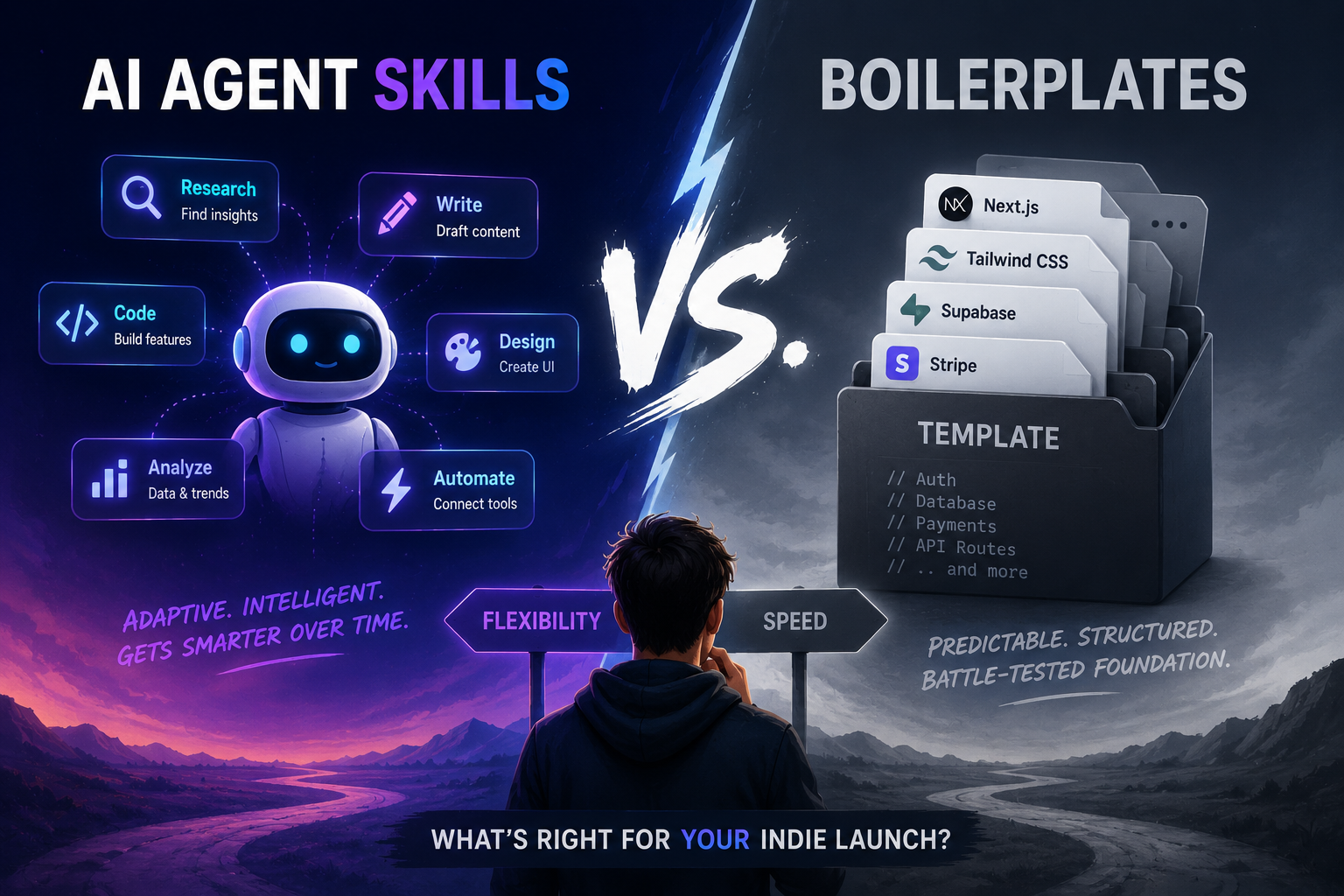
Boilerplates promise speed: clone, rename, deploy. Agent skills promise something different — repeatable judgment about how a product should be structured and launched.
Both can help. They solve different problems.
What a boilerplate optimizes for
A template gives you a fixed starting codebase:
- Opinionated folder structure
- Pre-wired auth or billing in one stack
- A design system you inherit whether or not it fits your brand
That is great when the template matches your vision. It is friction when you want a different UI library, an existing repo, or a pixel-art landing page beside a dashboard template you already own.
Templates answer: "Here is a repo." They do not answer: "How do I launch the next idea on Tuesday?"
What an AI agent skill optimizes for
LaunchNow is not a single codebase you fork. It is a collection of sub-skills your agent reads while building:
- Marketing site and SEO pack
- Dashboard and Supabase auth
- Stripe membership gate
- Static blog routes
- AWS deployment and env chaining
You attach one skill, describe the product, and the agent scaffolds only what you asked for — in the right order — then prints the few manual steps left (API keys, git push, deploy script).
Works with the tools you already use
LaunchNow does not require abandoning your stack. It is designed to compose with:
- SaaS boilerplates and dashboard templates
- Landing page starters and AI-generated UI
- Any UI library, coding style, or agent — Cursor, Claude Code, Codex, Gemini CLI, and others
You stay free to swap components and customize everything. The skill handles launch architecture: env layout, deploy orchestration, feature dependencies, and SEO defaults.
Comparison at a glance
Boilerplate
- Output: fixed repo snapshot
- Reuse across ideas: fork again; merge drift
- Stack lock-in: high
- Agent guidance: none
- Day-two updates: you maintain the fork
LaunchNow skill
- Output: generated project + deploy path
- Reuse across ideas: same workflow every launch
- Stack lock-in: low — modules optional
- Agent guidance: structured checklists + scripts
- Day-two updates: skill improvements flow to future runs
When to use which
Reach for a boilerplate when you want one known stack and plan to live inside it for years.
Reach for a launch skill when you validate many ideas, mix templates, or want your agent to own the repetitive glue — auth wiring, Stripe setup, sitemap generation, pipeline deploy — while you focus on the product story.
Already on another boilerplate?
No problem. LaunchNow can integrate into an existing frontend/ layout. It adds the launch workflow and automation your template never included — without throwing away code you have already written.
Teach your agent to launch, not just code
Your AI already knows how to write functions and components. The bottleneck is turning that output into something live, searchable, and billable.
That is the gap between a powerful coding agent and a product-building partner — and it is what a launch skill is for.
Ready to try the workflow? Start with the complete LaunchNow guide, see how LaunchNow works, or compare pricing.
Related reading: